IEEE Energy Sustainability Magazine launched its Volume 2, Issue 1 in February 2026, publishing a themed special issue titled Energy Sustainability with Computility–Electricity–Carbon Coordination . This special issue was led by Professor Kang Chongqing of the Department of Electrical Engineering (DEE), and co-organized with Dai Jing, Deputy Director of the Energy Governance Research Center at Tsinghua Institute for Energy Internet Innovation, and Du Ershun, Associate Researcher of the Low Carbon Energy Laboratory.
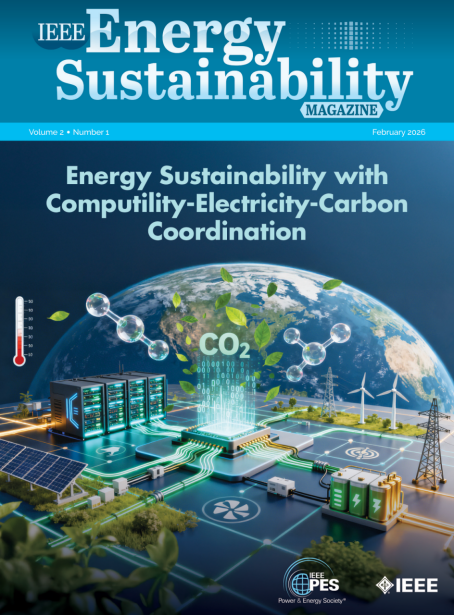
Cover of the IEEE Energy Sustainability Magazine Special Issue
In recent years, driven by the explosive development of large-scale AI models, the conflict between the expansion of computing centers (core infrastructure supporting computing services) and their huge energy consumption & carbon emissions has become a key bottleneck restricting global sustainable development. Statistical data showed that the global electricity consumption of computing centers reached 415 terawatt-hours (TWh) in 2024, accounting for approximately 1.5% of the world’s total power consumption. The International Energy Agency (IEA) predicted that carbon emissions from computing facilities in China and the United States would occupy 3%–4.5% of each country’s total carbon emissions by 2035. The 2026 Chinese Government Work Report incorporated "computing-power coordination" into new infrastructure plans for the first time, marking it as a vital strategic technological development direction of China.
The editorial team invited scholars from top universities, research institutions and industrial engineers across China, the United States, the United Kingdom, Denmark, Singapore, Australia and other countries to contribute papers, and finally collected 10 high-quality manuscripts. These papers delivered in-depth theoretical research and practical analysis focusing on three major themes: interactive technologies between sustainable AI and power systems, flexible operation technologies of computing hubs, and decarbonization frameworks for data centers.
Kang Chongqing, Dai Jing and Du Ershun co-wrote the Guest Editorial. They pointed out that Computility–Electricity–Carbon Coordination is both an emerging challenge and an innovative opportunity for energy sustainability. Through deep integration of efficient computing load dispatching, flexible power supply from renewable energy & smart grids, and full-lifecycle carbon-oriented decision-making, the industry can effectively tackle critical challenges including the low-carbon transformation of the AI computing industry, the grid integration and safe operation of renewable energy in new-type power systems, and collaborative planning of computing and energy infrastructure.
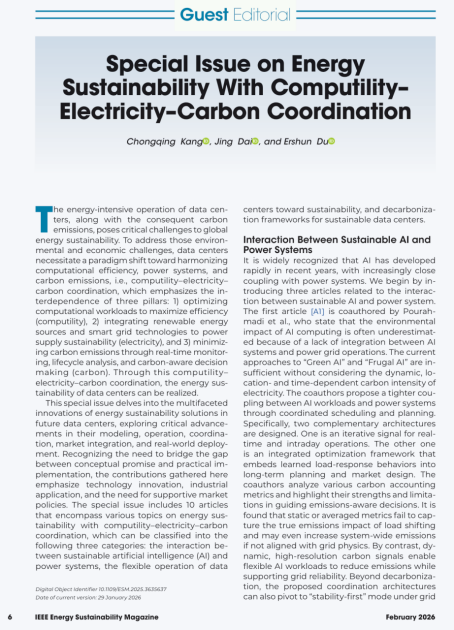
Guest Editorial of the IEEE Energy Sustainability Magazine Special Issue
Mohammad Shahidehpour, Editor-in-Chief of IEEE Energy Sustainability Magazine and Member of the U.S. National Academy of Engineering (NAE), shared his opinions in the Editor’s Voice column. He stated that the rapid growth of digital industries represented by AI has made high energy consumption and carbon emissions of data centers a major global sustainability challenge, and Computility–Electricity–Carbon Coordination provides an effective solution to this dilemma.
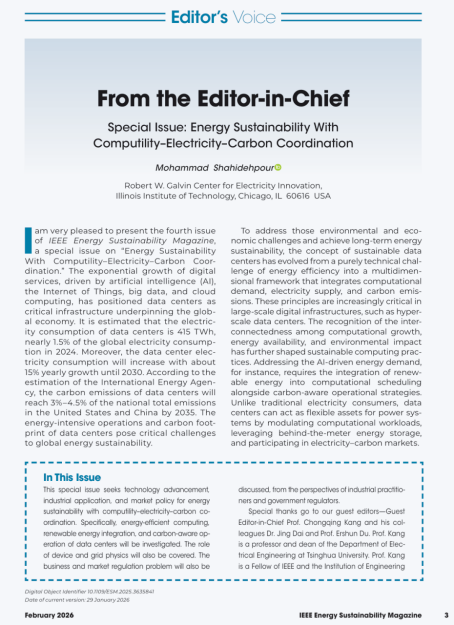
Editor’s Voice Column of IEEE Energy Sustainability Magazine
The launch of IEEE Energy Sustainability Magazine is a core initiative of the IEEE Power and Energy Society (PES) to respond to the global carbon neutrality movement and boost research on energy sustainability. The journal commits to disseminating cutting-edge theories and practical experience related to environmental sustainability and climate change in power system operation and planning. It is a quarterly journal that publishes flexible volumes of invited papers including regular articles and themed special issues. It helps industry practitioners and interdisciplinary researchers quickly grasp cutting-edge technologies in relevant fields.
Link:https://ieeexplore.ieee.org/xpl/tocresult.jspisnumber="11367116&punumber=10599323